
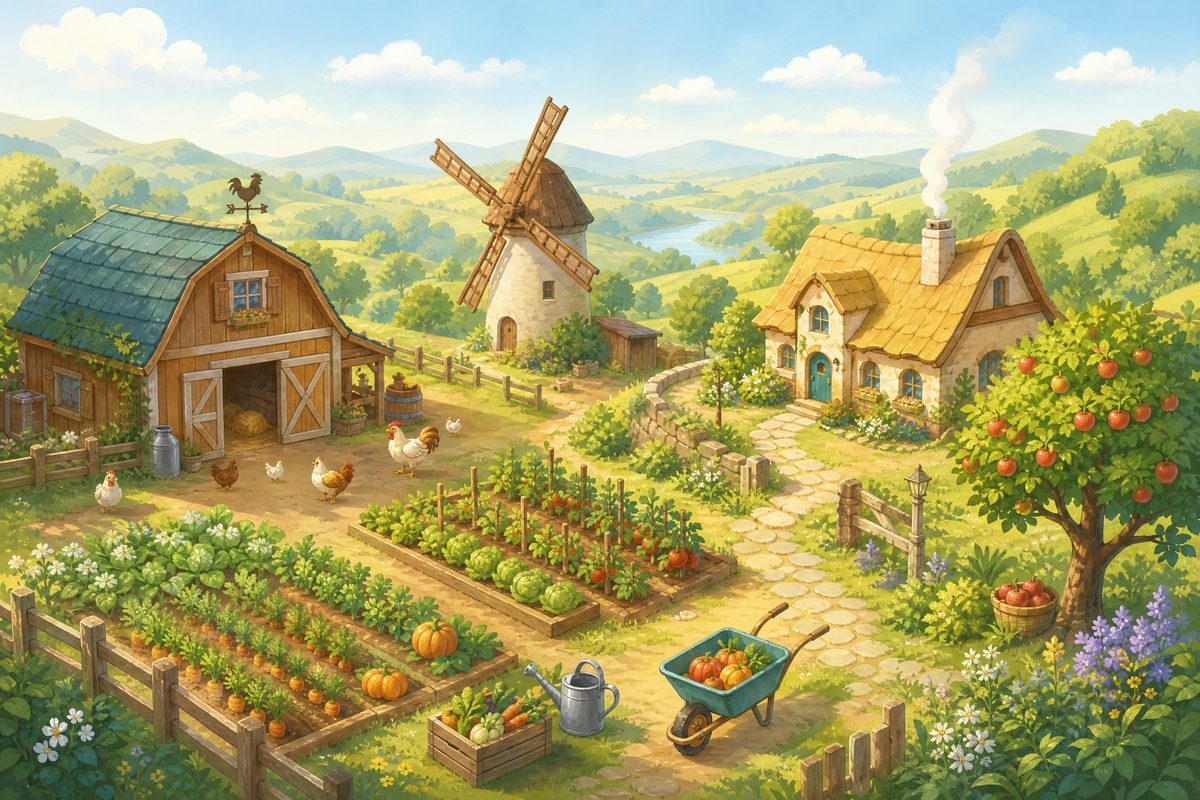
The highest score we have handed a simulation game went to something that begins with about as much drama as a bus timetable. You inherit a smallholding, you clear four fields of stones, you plant turnips because turnips are what the shop has. Nothing in the first two hours suggests a game that would keep me for fifty-eight of them. What does the work is a decision the developers made about time: in Clover Hollow, a day is short, a season is long, and almost nothing important can be completed inside a single one.
Why the calendar is the mechanic
Compare it with the standard structure of the genre, where a day is a self-contained puzzle: water everything, talk to two people, mine until your stamina runs out, sleep. Clover Hollow breaks that loop deliberately. Watering is automated within the first week if you build a single channel. Stamina barely exists. What replaces them is a calendar with genuine commitments on it.
The autumn market runs for three days and only three days. The neighbour who teaches cheese-making is away for the whole of summer. A frost warning appears two days before it lands, and if you have planted the wrong thing you lose the field — not to a difficulty spike, just to a date you failed to read. Once you understand this, the game stops being about labour and starts being about planning, which is a much more interesting activity to spend fifty hours on.
By the middle of year two I was not playing a farming game any more. I was running a small logistics operation against a fixed annual schedule, and the vegetables were merely the units.
The village is written, not generated
Nineteen residents, each with a hand-authored yearly routine and a genuinely conditional relationship track. This matters because the writing avoids the two failure states of the genre. Nobody is a walking quest dispenser, and nobody is defined by a single hobby repeated in every conversation.
The standout is the retired ferryman who spends the first year refusing to discuss why the eastern dock is closed, and whose eventual explanation reframes a piece of map you have been walking past for thirty hours. It is not a plot twist. It is better than that: a small, well-kept secret that only exists if you kept turning up.
Systems worth naming
- Weather forecasting. Two-day advance warning, always accurate, and it changes what you plant rather than just what you wear.
- Soil memory. Fields remember what grew in them for three seasons, which quietly forces rotation without a tutorial ever mentioning it.
- Festival economy. Four annual events where prices shift enough to reshape a whole season's plan.
- No combat. There are caves, but they contain minerals and puzzles rather than enemies, and the game is stronger for the omission.
Where it wobbles
Two real complaints. The first is the inventory, which is small for the first ten hours in a way that feels like artificial friction rather than considered scarcity; the upgrade that fixes it should be available on day one. The second is that year three has noticeably less to say. Once you have seen four seasons and attended each festival twice, the calendar's authored content largely runs out, and what remains is optimisation. That is a legitimate way to spend another hundred hours, but it is a different game from the one that earned the score.
| Configuration | Settings | Result |
|---|---|---|
| Current mid-range, 1440p | Maximum | Locked frame rate throughout; no dips even with a full farm |
| Six-year-old build, 1080p | High | Entirely stable; the art style costs almost nothing to render |
| Both configurations | Any | Save files load in under three seconds; autosave every in-game morning |
Who should play it
This is the farm sim for people who bounced off the genre because the daily loop felt like a chore list. It is also, quietly, one of the better planning games on PC. If you want a cosy background activity you can play while half-watching something else, look elsewhere — Clover Hollow expects you to read the calendar, and it will happily let you ruin a season if you do not.