
Roughly ninety minutes into Hollow Tide, I stopped at a crossroads and realised nothing on screen was going to tell me where to go. There was no glowing edge on the horizon, no arrow, no distance counter. What there was instead: a stone marker leaning east, a column of smoke somewhere past a treeline, and a river running the wrong way for the direction I had planned. I picked the smoke. It took eleven minutes to reach and turned out to be a burnt-out waystation with a locked cellar I could not open for another twelve hours of play.
That sequence is the entire game in miniature. Hollow Tide is built on the assumption that a player who is allowed to be wrong will pay closer attention than a player who is being guided, and for the most part it is correct. It is also the reason the game will lose some people in its first evening, and why the score below is not a ten.
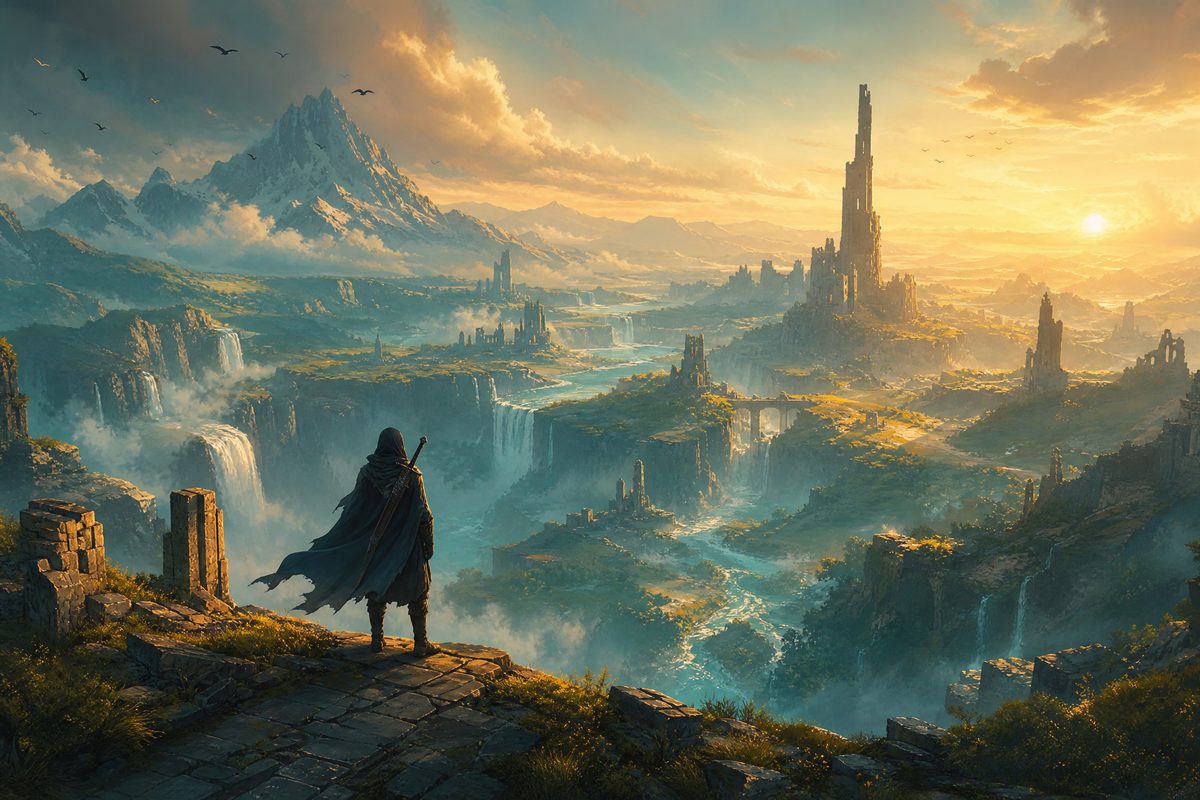
Navigation as the actual mechanic
The map you carry is hand-drawn and deliberately incomplete. It shows coastlines, major ridges and a handful of ruins, but it does not show you. There is no player dot. Working out your position means matching what the parchment claims against what you can see, which in practice means learning the silhouette of four or five mountains and using them the way you would use signposts.
This sounds tedious. It is, for about two hours. Then something switches. By hour ten I was navigating by memory across a region I had crossed twice, recognising a particular dead tree as the turn toward the southern bridge. That feeling — knowing a fictional place well enough to move through it without thinking — is something almost no modern open world delivers, because almost all of them solve navigation for you before you have a chance to learn it.
The design bet is simple: a world you had to learn is a world you remember. After forty-two hours I could sketch the southern half of this map from memory, and I have played games with three times the runtime whose geography I could not describe at all.
Where the second act loses its nerve
Around hour eighteen, Hollow Tide starts doubting itself. The third region introduces a faction questline that behaves like it wandered in from a different, more conventional game: a list of five tasks, given in one conversation, completed in whatever order you like, each one a short trip to a marked location. Marked, note. The game switches its own rules off for roughly six hours, and the drop in tension is severe.
It is not that these hours are broken. The combat still works, the writing is still sharp, and one of the five tasks contains the best single environment in the game. But the shift exposes how much of the earlier magic came from restraint. When the map tells you where to stand, Hollow Tide becomes an averagely good action adventure with unusually pretty scenery.
What actually goes wrong, specifically
- Pacing collapse. Five tasks issued at once flattens a game that had been feeding you one thread at a time.
- Marker inconsistency. Having removed waypoints for eighteen hours, reintroducing them reads as a loss of confidence rather than a design choice.
- Combat repetition. The enemy roster stops expanding here, and it never fully recovers in the final act.
- Fast travel bloat. Six new shrines unlock in quick succession, which quietly undoes the value of knowing the terrain.
The last five hours
Then it remembers what it is. The final region strips the markers back out, removes fast travel entirely, and asks you to reach a location you have been able to see on the horizon since the opening ridge. There is no path. There is a lake, a collapsed aqueduct, and about forty minutes of genuinely uncertain movement, and it is the best sustained stretch of open-world design I have played since the last time a studio was brave enough to leave the screen empty.
The ending does not resolve everything, and one character's arc closes with an abruptness that felt like a cut for time. I did not mind. By that point the game had earned enough goodwill that a rough edge read as texture.
Performance and hardware
We ran the full playthrough twice over: once on a current mid-range desktop and once on a six-year-old build, both on Windows, both on patch 1.4.2.
| Configuration | Settings | Result |
|---|---|---|
| Current mid-range, 1440p | High, no upscaling | Locked 60 outside two forest zones; brief dips to 48 in heavy rain |
| Six-year-old build, 1080p | Medium, shadows low | Stable 50–55; traversal stutter for the first hour of each session |
| Both configurations | Any | Shader compilation on first launch takes four to six minutes; do not skip it |
Two crashes across eighty-four combined hours, both when alt-tabbing during a cutscene. Save integrity was never affected. Loading a save takes eleven seconds on the older machine, which matters more than it sounds in a game with no death penalty beyond walking back.
Who should play it
If you have ever complained that open worlds feel like checklists, this is the game that answers you, and you should accept that the first two hours will feel like being dropped in a forest without shoes. If you play in forty-minute sessions after work, be warned: Hollow Tide punishes interruption. Coming back after a week away means relearning where you were, because the game will not remind you.
It is not a masterpiece. It is something more useful — a large, confident, slightly uneven game that proves an idea most of the industry decided was too risky. On that basis alone it is worth the forty-two hours.